Print Reading for Construction Residential and Commercial 7th Edition
9 min. read
PMI announced the PMBOK® seventh Edition exposure draft in January 2020 for the review of the project management customs. PMBOK 7th Edition will be released on the 1st of Baronial, 2021. If you are looking to go your PMP certification, PMBOK is one of the most important resources when getting set for the PMP exam. Most of the PMP grooming providers set PMP study materials and resources based on the PMBOK content. Therefore, PMBOK 7th edition will be the guide for PMP and CAPM certification tracks of PMI and the training providers will be updating their materials based on this modify.
Attend our 100% Online & Self-Paced One-Hr Free PMP Training.

We have gone through the PMBOK seventh Edition Exposure Draft, PMI resources regarding PMBOK seventh changes, and tried to detail what is irresolute in the new PMBOK.
When will the PMBOK7th Edition exist published?
Based on PMI pages, PMBOK 7th Edition is scheduled for release on the 1st of August 2021. Nonetheless, the PMP exam volition not be based on PMBOK 7th Ed right later on release. Nosotros are expecting that the PMP examination will exist based on PMBOK 7th Ed past Jan 2022. This will give time to training providers to update their training content based on the new PMBOK changes.
Why is PMBOK® changing?
Until now, PMBOK was mainly focusing on waterfall project direction techniques. Still, with the fast pace of technology, contest is harsher than it was never before. Product life cycles are shorter and requirements of the product or projection can change over time depending on the progress of the project.
With conventional project direction approaches, it is not possible to welcome apace irresolute requirements to the projects. That is why agile projection management methods and approaches emerged in the 2000s. These agile frameworks started to be adopted by many organizations in projection direction, especially in the It and software industry.
PMP is the near reputable project direction certification effectually the world with almost one million PMP-certified professionals. PMBOK is the courage of the PMP certification examination content. Since the project management dynamics, popular frameworks, and trends are irresolute, PMBOK must be relevant to the changing dynamics of the project management profession likewise. That is the main reason why PMBOK is irresolute every iii to 5 years.
Watch Alan'due south "New" PMP® Test Journeying Interview
What is irresolute in PMBOK Guide – Seventh Edition
If you would inquire me to summarize what is changing in PMBOK Seventh Edition in one sentence, I would say
PMBOK 7th Edition will be based on principles rather than processes and it will be much shorter than the electric current edition.
Depending on the projection characteristics, manufacture, requirements of the stakeholders and organisation, project managers tend to utilise dissimilar approaches when delivering projects. These approaches can be predictive, agile, hybrid or waterfall. The important point is, project management standards must not be favoring 1 arroyo on some other. Project management standards must focus on successful project and value delivery.
Scout our "What is irresolute in PMBOK® Seventh Edition?" video
Principle vs Process-Based Projection Management
In PMBOK Seventh edition, project management standards will be principle-based rather than processes. In that location are PMBOK cognition areas in electric current and previous PMBOKs and each noesis surface area has processes, inputs, tools, techniques, and outputs. These processes will not exist available in PMBOK 7th Edition. There will exist principles that are generally accepted and adept in project management. While current and previous PMBOK editions were focusing on deliverables, evolving project dynamics focus on overall project outcomes and new PMBOK volition focus on outcomes rather than deliverables.
This does not mean that process-based approaches are not relevant or useful anymore. Many organizations and project management practitioners keep to employ conventional project management delivery methods. Conventional approaches remain relevant in the context of PMBOK 7th Edition as well.
In PMBOK seventh Edition, projects do non merely produce products or deliverables. Projects deliver outcomes and these outcomes bring value to the organization and its stakeholders.
Visual Summary of PMBOK 7th Edition Changes
Based on PMBOK 7th Edition exposure draft and PMI announcement following are the changes from PMBOK sixth Edition to PMBOK 7th Edition.
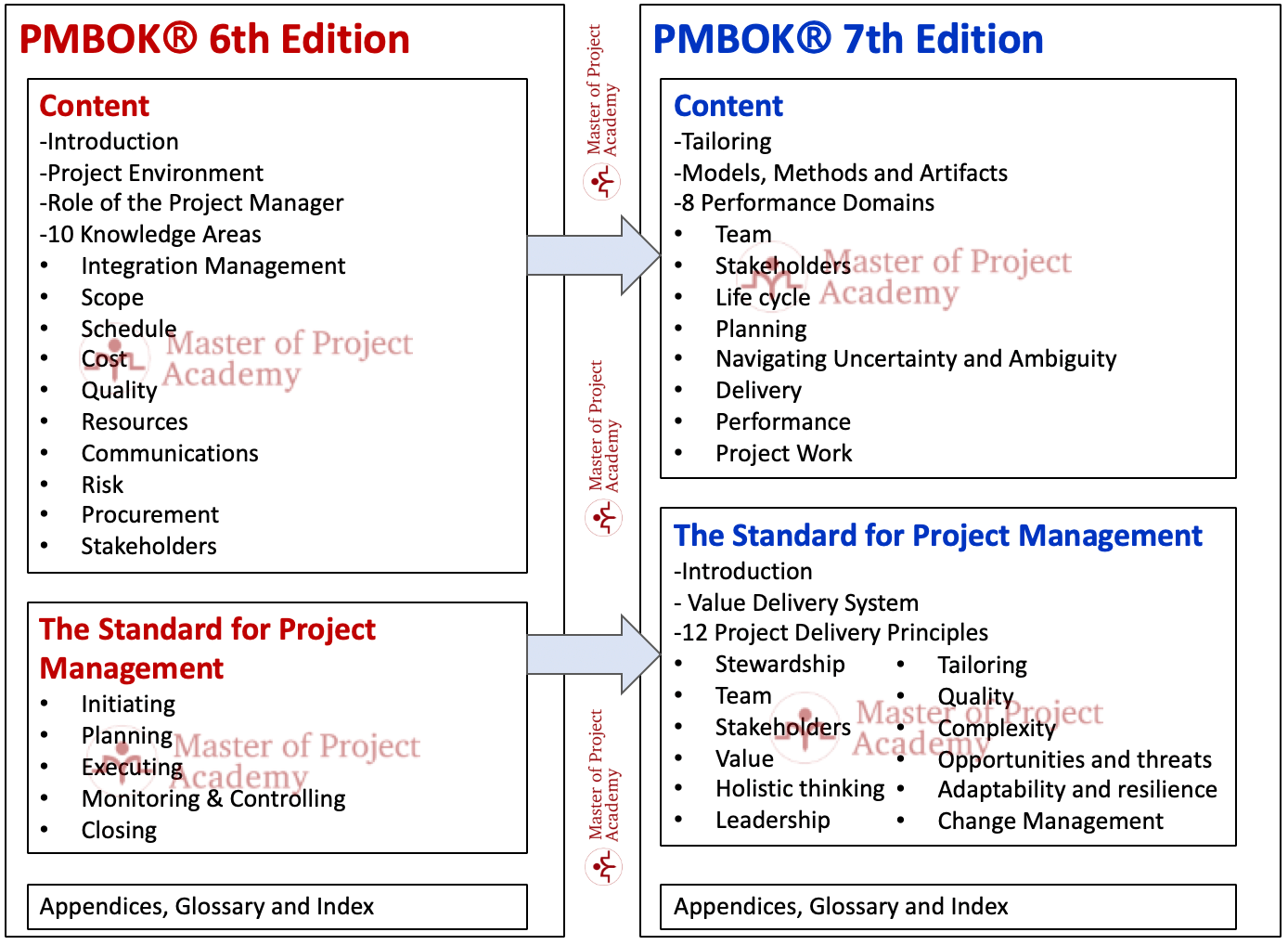
There are three introduction chapters in PMBOK then 10 knowledge areas in PMBOK sixth Edition. In PMBOK 7th Edition, instead of cognition areas, at that place will be performance domains.In that location will be Tailoring, Models, Methods and Artifacts chapters likewise.
PMBOK sixth Edition has five project management process groups: initiating, planning, executing, monitoring & controlling and closing. These are referred to equally the five stages of a project lifecycle as well. For each cognition expanse, there are processes belonging to these procedure groups. For instance, the estimate costs process is a process belonging to the planning process grouping and cost direction knowledge area.
In PMBOK 7th edition, at that place volition exist a shift from the process-based approach to the principle-based approach. There volition be 12 Projection Commitment Principles and a Value Delivery Organisation. The Value Delivery System will focus on delivering valuable outcomes rather than deliverables. Projects are fundamental components of the Value Commitment System and principles will guide the Projection Managers, Squad Members and stakeholders on how to achieve intended outcomes to deliver value to the organization and stakeholders.
Value Delivery System
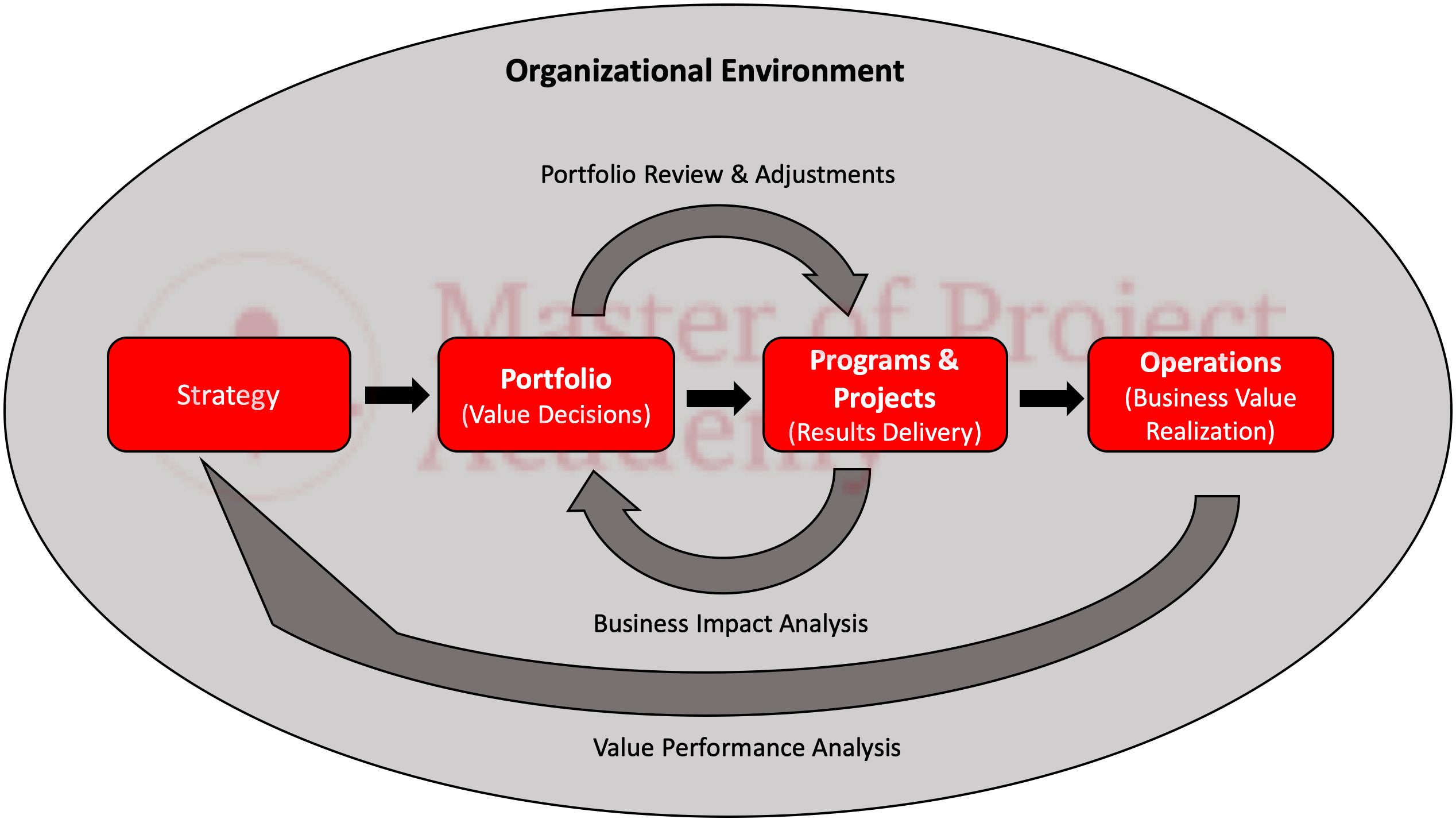
The effigy above shows the "Value Delivery Organisation" approach coming with PMBOK 7th Edition. Based on this system, strategies, missions or objectives of an organisation decides the next portfolios or investments. Portfolios can include sub-portfolios, programs or projects. To ensure the objectives of the portfolios, plan and project commitment must reach its intended targets. Based on the outcomes of the projects, concern impacts are analyzed and portfolios are reviewed or adjusted for future steps.
Once the projects are delivered successfully, expected business concern values must be earned to the organization as well.This is called "Business concern Value Realization". Based on the realized business organization values and outcomes of the delivered projects, organizations derive their strategy to initiate new portfolios.
Project teams can produce outcomes by using different commitment approaches. For some projects, activities might be clear and the results can be achieved by completing the activities. However, for some projects, there might be ongoing activities, monitoring and elaborating the outcomes of previous activities to make up one's mind the side by side steps in the project. The "project management" might not be an appropriate term for some projects. Therefore, "project delivery" is used instead of "projection management" in PMBOK 7th edition to comprehend outcomes as well as deliverables of a project.
Projection Delivery Principles
At that place will exist 12 principles in PMBOK seventh edition and these principles ascertain the "what" and "why" of the project commitment. Projection commitment principles describe a fundamental truth, norm, or value and not prescriptive. In order to ensure the intended outcomes of the projection delivery, project team members must follow these principles. The following are the 12 principles.
1-) Stewardship: Be a diligent, respectful, and caring steward.
2-) Team: Build a culture of accountability and respect.
3-) Stakeholders: Engage stakeholders to sympathise their interests and needs.
four-) Value: Focus on value.
5-) Holistic Thinking: Recognize and reply to systems' interactions.
6-) Leadership: Motivate, influence, double-decker, and larn.
7-) Tailoring: Tailor the delivery approach based on context.
eight- ) Quality: Build quality into processes and results.
9-) Complication: Address complexity using knowledge, experience, and learning.
10-) Opportunities & Threats: Address opportunities and threats.
xi-) Adaptability & Resilience: Exist adaptable and resilient.
12-) Alter Management: Enable change to achieve the envisioned hereafter state.
New Platform Coming with PMBOK 7th Edition: The Standards Plus™ Interactive Digital Content Platform
The Standards Plus™ interactive digital content platform will be linked to PMBOK 7th Edition via the Models, Methods and Artifacts department. This platform volition reverberate "how to…" nearly current, emerging and future practices, methods, artifacts, and other useful information. Standards Plus aims to get-go with ITTOs from PMBOK Sixth Edition and incorporate new resource since the project management is evolving.
Visual from PMI Regarding Changes from the PMBOK 6th Edition to the PMBOK 7th Edition
PMI recently shared the post-obit visual regarding the changes from PMBOK 6th to seventh Edition.
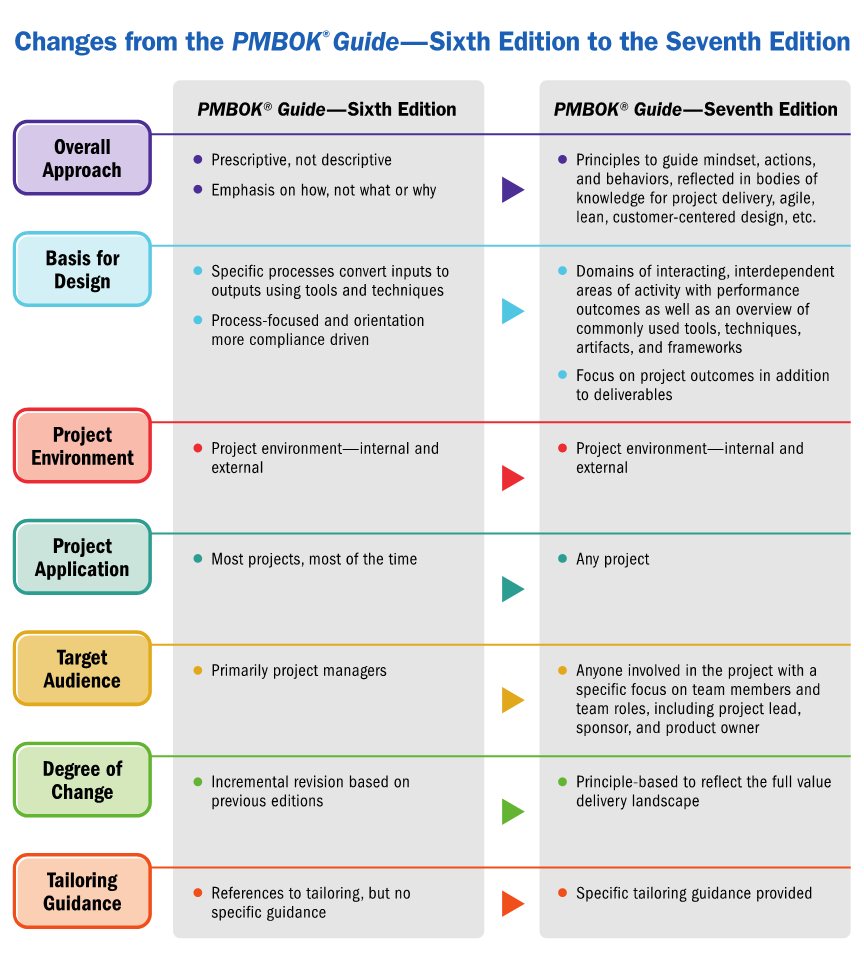
How is PMBOK® Updated?
Following is the six-step followed by PMI to update PMBOK.
- PMI charters a volunteer committee to develop or update a standard.
- The volunteer committee drafts and/or refines an existing standard.
- A group of discipline matter experts review initial drafts of the standard and provide feedback to the committee.
- The commission revises the draft standard and prepares a document for public review and comment. The committee considers input from the public and may revise the standard in response. -> We meet the PMBOK exposure draft at the end of this step.
- The final standard is presented the PMI Standards Consensus Committee which consists of volunteers from the profession for concluding validation.
- The new standard is submitted for canonical by the PMI Managing director, Standards & Publications before it is released
PMBOK Seventh Edition exposure typhoon has been published for public review and comment on 15 January 2020 and review/comment was available until 14 February 2020. Based on the reviews and comments, PMI volition exist working on the development of PMBOK 7th Edition. The planned release engagement for PMBOK Seventh Edition is August 1st, 2021.
Summary of PMBOK Seventh Edition Changes
We accept gone through the exposure draft of PMBOK 7th Edition and PMI announcements to review what the changes will be in PMBOK seventh Edition. The biggest modify is the shift from "process-based project management" to "principle-based project commitment". Instead of processes, inputs, outputs, tools, and techniques, project delivery focuses on principles and outcomes.
Knowledge areas will not be existing in PMBOK anymore. At that place volition exist performance domains.There will be a new digital platform: Standards Plus linked to PMBOK. This platform volition show current, emerging and hereafter project commitment practices for the employ of project practitioners.
PMI is planning to release PMBOK Seventh Edition past Baronial 1st, 2021. You tin can read about the previous July 2020 changes in our PMP exam changes post. The latest change to the PMP exam happened on Jan 2d, 2021.
The PMBOK 7th Edition has radical changes and a large modify from waterfall project direction techniques to agile and holistic project commitment methods. Nosotros recommend preparing and sitting for the PMP exam before the changes. You can attend our PMP training before the changes.
Source: https://blog.masterofproject.com/pmbok-7th-edition/
0 Response to "Print Reading for Construction Residential and Commercial 7th Edition"
Postar um comentário