Is Anyone Allowed in the Reading Room of the Library of Congress
Coordinates: 38°53′19″N 77°00′17″W / 38.88861°North 77.00472°Westward / 38.88861; -77.00472
| Library of Congress | |
|---|---|
 | |
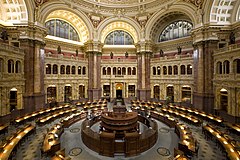 Main reading room | |
| Established | April 24, 1800 |
| Location | Washington, D.C. |
| Collection | |
| Size | 171 one thousand thousand items[a] |
| Access and use | |
| Circulation | Onsite utilize only |
| Population served | Congress and nation |
| Other data | |
| Budget | $684.04 meg[ii] |
| Director | Carla Hayden |
| Staff | 3,105[2] |
| Website | LoC.gov |
The Library of Congress (LC) is the research library that officially serves the United States Congress and is the de facto national library of the United States. It is the oldest federal cultural establishment in the country. The library is housed in three buildings on Capitol Hill in Washington, D.C.; it too maintains a conservation center in Culpeper, Virginia.[iii] The library's functions are overseen by the Librarian of Congress, and its buildings are maintained by the Architect of the Capitol. The Library of Congress is i of the largest libraries in the world.[4] [5] Its "collections are universal, not express by discipline, format, or national boundary, and include research materials from all parts of the world and in more than 450 languages."[3]
Congress moved to Washington, D.C., in 1800 later holding sessions for 11 years in the temporary national capitals in New York City and Philadelphia. In both cities, members of the U.Due south. Congress had access to the sizable collections of the New York Society Library and the Library Visitor of Philadelphia.[6] The small Congressional Library was housed in the United States Capitol for near of the 19th century until the early 1890s.
Most of the original collection was burnt by the British during the War of 1812, with the library beginning efforts to restore its collection in 1815. The library purchased Thomas Jefferson's entire personal collection of 6,487 books, and its collection slowly expanded in the following years, although information technology suffered another fire in its Capitol chambers in 1851. This destroyed a large corporeality of the collection, including many of Jefferson's books. Afterwards the American Civil State of war, the importance of the Library of Congress increased with its growth, and at that place was a campaign to purchase replacement copies for volumes that had been burned. The library received the right of transference of all copyrighted works to deposit two copies of books, maps, illustrations, and diagrams printed in the Usa. It besides began to build its collections. Its development culminated between 1888 and 1894 with the construction of its own separate, large library edifice across the street from the Capitol. 2 additional buildings have been constructed nearby to concord collections and provide services, one in the 1930s and one in the 1970s.
The library's primary mission is to research inquiries fabricated past members of Congress, which is carried out through the Congressional Enquiry Service. It too houses and oversees the United States Copyright Office. The library is open to the public for inquiry, although only high-ranking regime officials and library employees may check out (i.eastward., remove from the bounds) books and materials.[vii]
History [edit]
1800–1851: Origin and Jefferson's contribution [edit]
James Madison of Virginia is credited with the thought of creating a congressional library, beginning making such a proposition in 1783.[8] The Library of Congress was after established on April 24, 1800, when President John Adams signed an act of Congress besides providing for the transfer of the seat of government from Philadelphia to the new capital urban center of Washington. Office of the legislation appropriated $5,000 "for the purchase of such books every bit may be necessary for the use of Congress ... and for plumbing fixtures upward a suitable flat for containing them."[nine] Books were ordered from London, and the collection consisted of 740 books and three maps, which were housed in the new United States Capitol.[10]
President Thomas Jefferson played an important role in establishing the structure of the Library of Congress. On January 26, 1802, he signed a bill that allowed the president to engage the librarian of Congress and establishing a Joint Commission on the Library to regulate and oversee it. The new law likewise extended borrowing privileges to the president and vice president.[xi] [12]
In Baronial 1814, later routing an American ground forces at Bladensburg, the British bloodlessly occupied Washington, D.C. In retaliation for the American devastation of Port Dover, the British ordered the devastation of numerous public buildings in the city. British troops burned the Library of Congress, including its collection of 3,000 volumes.[x] These volumes had been held in the Senate wing of the Capitol.[12] [13] One of the few congressional volumes to survive was a government business relationship book of receipts and expenditures for 1810.[14] It was taken equally a gift by British naval officer Sir George Cockburn, whose family returned it to the The states government in 1940.[fifteen]
Within a month, Thomas Jefferson offered to sell his big personal library[16] [17] [xviii] every bit a replacement. Congress accustomed his offer in January 1815, appropriating $23,950 to purchase his 6,487 books.[10] Some members of the House of Representatives opposed the outright purchase, including New Hampshire representative Daniel Webster. He wanted to render "all books of an atheistical, irreligious, and immoral tendency".[nineteen]
Jefferson had spent 50 years accumulating a broad variety of books in several languages, and on subjects such equally philosophy, history, law, religion, architecture, travel, natural sciences, mathematics, studies of classical Greece and Rome, modern inventions, hot air balloons, music, submarines, fossils, agriculture, and meteorology.[viii] He had as well collected books on topics not usually viewed equally office of a legislative library, such as cookbooks. Merely, he believed that all subjects had a identify in the Library of Congress. He remarked:
I exercise not know that it contains whatever branch of science which Congress would wish to exclude from their collection; there is, in fact, no bailiwick to which a Fellow member of Congress may non have occasion to refer.[19]
Jefferson's collection was unique in that it was the working collection of a scholar, non a admirer's collection for display. With the addition of his collection, which doubled the size of the original library, the Library of Congress was transformed from a specialist'southward library to a more general one.[20] His original collection was organized into a scheme based on Francis Bacon'southward organisation of knowledge. Specifically, Jefferson had grouped his books into Retentivity, Reason, and Imagination, and broke them into 44 more subdivisions.[21] The library followed Jefferson'due south organization scheme until the late 19th century, when librarian Herbert Putnam began work on a more flexible Library of Congress Classification construction. This now applies to more than 138 million items.
1851–1865: Weakening [edit]

On December 24, 1851, the largest burn down in the library'south history destroyed 35,000 books, about two–thirds of the library'due south drove and two-thirds of Jefferson's original transfer. Congress appropriated $168,700 to replace the lost books in 1852 only non to acquire new materials[22] (By 2008, the librarians of Congress had found replacements for all but 300 of the works that had been documented as existence in Jefferson's original collection.[23]) This marked the starting time of a conservative menses in the library's administration by librarian John Silva Meehan and articulation committee chairman James A. Pearce, who restricted the library's activities.[22] Meehan and Pearce's views about a restricted scope for the Library of Congress reflected those shared by members of Congress. While Meehan was librarian, he supported and perpetuated the notion that "the congressional library should play a limited role on the national scene and that its collections, past and large, should emphasize American materials of obvious utilise to the U.S. Congress."[24] In 1859, Congress transferred the library'due south public document distribution activities to the Section of the Interior and its international book exchange programme to the Department of State.[25]
During the 1850s, Smithsonian Institution librarian Charles Coffin Jewett aggressively tried to develop the Smithsonian as the United States' national library. His efforts were blocked by Smithsonian secretary Joseph Henry, who advocated a focus on scientific inquiry and publication.[26] To reinforce his intentions for the Smithsonian, Henry established laboratories, developed a robust physical sciences library, and started the Smithsonian Contributions to Knowledge, the offset of many publications intended to disseminate research results.[27] For Henry, the Library of Congress was the obvious choice every bit the national library. Unable to resolve the conflict, Henry dismissed Jewett in July 1854.
In 1865 the Smithsonian building, also called the Castle due to its Norman architectural manner, was severely damaged by fire. This incident presented Henry with an opportunity related to the Smithsonian'due south not-scientific library. Effectually this fourth dimension, the Library of Congress was making plans to build and relocate to the new Thomas Jefferson Building, designed to be fireproof.[28] Authorized by an act of Congress, Henry transferred the Smithsonian'due south non-scientific library of 40,000 volumes to the Library of Congress in 1866.[29]
President Abraham Lincoln appointed John Thou. Stephenson every bit librarian of Congress in 1861; the date is regarded as the almost political to date.[thirty] Stephenson was a doc and spent equal time serving as librarian and as a medico in the Marriage Ground forces. He could manage this sectionalisation of interest because he hired Ainsworth Rand Spofford as his banana.[30] Despite his new job, Stephenson focused on the state of war. Three weeks into his term as Librarian of Congress, he left Washington, D.C. to serve equally a volunteer adjutant-de-camp at the battles of Chancellorsville and Gettysburg during the American Civil War.[thirty] Stephenson's hiring of Spofford, who directed the library in his absence, may take been his about pregnant accomplishment.[thirty]
1865–1897: Spofford'southward expansion [edit]
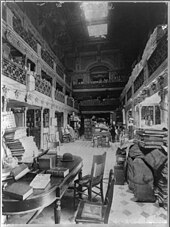
Library of Congress in the Capitol Building in the 1890s
Librarian Ainsworth Rand Spofford, who directed the Library of Congress from 1865 to 1897, built broad bipartisan support to develop it as a national library and a legislative resource.[31] [32] He was aided by expansion of the federal government after the war and a favorable political climate. He began comprehensively collecting Americana and American literature, led the structure of a new edifice to business firm the library, and transformed the librarian of Congress position into one of forcefulness and independence. Betwixt 1865 and 1870, Congress appropriated funds for the construction of the Thomas Jefferson Edifice, placed all copyright registration and eolith activities under the library's control, and restored the international book exchange. The library besides acquired the vast libraries of the Smithsonian and of historian Peter Force, strengthening its scientific and Americana collections significantly. By 1876, the Library of Congress had 300,000 volumes; it was tied with the Boston Public Library as the nation'southward largest library. Information technology moved from the Capitol building to its new headquarters in 1897 with more than 840,000 volumes, 40 percent of which had been acquired through copyright eolith.[10]
A year before the library'south relocation, the Articulation Library Committee held hearings to assess the condition of the library and plan for its futurity growth and possible reorganization. Spofford and half dozen experts sent by the American Library Association[33] testified that the library should continue its expansion to become a true national library. Based on the hearings, Congress authorized a budget that allowed the library to more than double its staff, from 42 to 108 persons. Senators Justin Morrill of Vermont and Daniel W. Voorhees of Indiana were particularly helpful to gaining this back up. The library also established new authoritative units for all aspects of the collection. In its bill, Congress strengthened the role of Librarian of Congress: it became responsible to govern the library and make staff appointments. Equally with presidential Cabinet appointments, the Senate was required to approve presidential appointees to the position.[x]
1897–1939: Post-reorganization [edit]

Library of Congress in its new Thomas Jefferson building in 1902
With this back up and the 1897 reorganization, the Library of Congress began to abound and develop more rapidly. Spofford's successor John Russell Young overhauled the library's bureaucracy, used his connections as a one-time diplomat to larn more materials from effectually the world, and established the library's first assistance programs for the blind and physically disabled.
Young'south successor Herbert Putnam held the part for forty years from 1899 to 1939. Ii years afterwards he took office, the library became the first in the United States to concord one million volumes.[x] Putnam focused his efforts to make the library more than accessible and useful for the public and for other libraries. He instituted the interlibrary loan service, transforming the Library of Congress into what he referred to as a "library of final resort".[34] Putnam too expanded library admission to "scientific investigators and duly qualified individuals", and began publishing chief sources for the benefit of scholars.[10]
During Putnam'south tenure, the library broadened the diversity of its acquisitions. In 1903, Putnam persuaded President Theodore Roosevelt to employ executive gild to transfer the papers of the Founding Fathers from the Land Department to the Library of Congress. Putnam expanded strange acquisitions too, including the 1904 purchase of a four-thousand volume library of Indica, the 1906 purchase of G. V. Yudin'due south eighty-thou volume Russian library, the 1908 Schatz collection of early opera librettos, and the early 1930s purchase of the Russian Imperial Collection, consisting of ii,600 volumes from the library of the Romanov family on a diverseness of topics. Collections of Hebraica, Chinese, and Japanese works were also acquired. On one occasion, Congress initiated an acquisition: in 1929 Congressman Ross Collins (D-Mississippi) gained blessing for the library to purchase Otto Vollbehr'due south drove of incunabula for $ane.v meg. This collection included one of iii remaining perfect vellum copies of the Gutenberg Bible.[35] [x]

Putnam established the Legislative Reference Service (LRS) in 1914 as a separative administrative unit of the library. Based in the Progressive era's philosophy of scientific discipline to be used to solve problems, and modeled afterwards successful research branches of state legislatures, the LRS would provide informed answers to Congressional research inquiries on virtually any topic.
Congress passed in 1925 an act allowing the Library of Congress to plant a trust fund board to take donations and endowments, giving the library a part as a patron of the arts. The library received donations and endowments past such prominent wealthy individuals as John D. Rockefeller, James B. Wilbur, and Archer Thousand. Huntington. Gertrude Clarke Whittall donated five Stradivarius violins to the library. Elizabeth Sprague Coolidge'southward donations paid for a concert hall to exist synthetic within the Library of Congress edifice and an honorarium established for the Music Partitioning to pay live performers for concerts. A number of chairs and consultantships were established from the donations, the almost well-known of which is the Poet Laureate Consultant.[10]
The library'due south expansion eventually filled the library's Main Building, although information technology used shelving expansions in 1910 and 1927. The library needed to expand into a new structure. Congress caused nearby land in 1928 and approved construction of the Annex Edifice (afterwards known as the John Adams Edifice) in 1930. Although delayed during the Depression years, it was completed in 1938 and opened to the public in 1939.[ten]
1939–1987: National versus legislative role [edit]

After Putnam retired in 1939, President Franklin D. Roosevelt appointed poet and writer Archibald MacLeish as his successor. Occupying the mail from 1939 to 1944 during the elevation of Earth State of war II, MacLeish became the most widely known librarian of Congress in the library's history. MacLeish encouraged librarians to oppose totalitarianism on behalf of democracy; dedicated the South Reading Room of the Adams Edifice to Thomas Jefferson, and commissioning creative person Ezra Wintertime to paint 4 themed murals for the room. He established a "democracy alcove" in the Principal Reading Room of the Jefferson Building for important documents such as the Annunciation of Independence, the Constitution, and The Federalist Papers. The Library of Congress assisted during the war try, ranging from storage of the Declaration of Independence and the United States Constitution in Fort Knox for safekeeping, to researching weather data on the Himalayas for Air Strength pilots. MacLeish resigned in 1944 when appointed every bit Banana Secretarial assistant of Land.
President Harry Truman appointed Luther H. Evans every bit librarian of Congress. Evans, who served until 1953, expanded the library's acquisitions, cataloging and bibliographic services. But he is best known for creating Library of Congress Missions effectually the world. Missions played a variety of roles in the postwar world: the mission in San Francisco assisted participants in the meeting that established the United Nations, the mission in Europe acquired European publications for the Library of Congress and other American libraries, and the mission in Japan aided in the creation of the National Diet Library.[10]

Adams Edifice – South Reading Room, with murals by Ezra Winter
Evans' successor Lawrence Quincy Mumford took over in 1953. During his tenure, lasting until 1974, Mumford directed the initiation of construction of the James Madison Memorial Building, the tertiary Library of Congress building on Capitol Colina. Mumford directed the library during a menses of increased educational spending by the government. The library was able to establish new acquisition centers abroad, including in Cairo and New Delhi. In 1967, the library began experimenting with book preservation techniques through a Preservation Office. This has adult as the largest library enquiry and conservation attempt in the United States.
During Mumford'south administration, the last major public debate occurred well-nigh the Library of Congress'south function every bit both a legislative library and a national library. Asked by Joint Library Committee chairman Senator Claiborne Pell (D-RI) to assess operations and make recommendations, Douglas Bryant of Harvard Academy Library proposed a number of institutional reforms. These included expansion of national activities and services and various organizational changes, all of which would emphasize the library's national role rather than its legislative role. Bryant suggested irresolute the name of the Library of Congress, a recommendation rebuked by Mumford as "unspeakable violence to tradition". The debate continued within the library customs for some fourth dimension. The Legislative Reorganization Deed of 1970 renewed emphasis for the library on its legislative roles, requiring greater focus on research for Congress and congressional committees, and renaming the Legislative Reference Service equally the Congressional Research Service.[x]
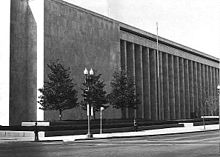
After Mumford retired in 1974, President Gerald Ford appointed historian Daniel J. Boorstin as librarian. Boorstin's start claiming was to manage the relocation of some sections to the new Madison Building, which took identify between 1980 and 1982. With this accomplished, Boorstin focused on other areas of library administration, such as acquisitions and collections. Taking advantage of steady budgetary growth, from $116 1000000 in 1975 to over $250 million by 1987, Boorstin enhanced institutional and staff ties with scholars, authors, publishers, cultural leaders, and the business community. His activities changed the mail of librarian of Congress and then that by the time he retired in 1987, The New York Times called this role "maybe the leading intellectual public position in the nation".
1987–present: Digitization and programs [edit]
President Ronald Reagan nominated historian James H. Billington as the 13th librarian of Congress in 1987, and the U.South. Senate unanimously confirmed the engagement.[37] Nether Billington's leadership, the library doubled the size of its analog collections from 85.5 meg items in 1987 to more than than 160 one thousand thousand items in 2014. At the same time, it established new programs and employed new technologies to "get the champagne out of the bottle". These included:
- American Memory created in 1990, which became the National Digital Library in 1994. It provides gratuitous access online to digitized American history and culture resources, including principal sources, with curatorial explanations to back up use in K-12 teaching.[38]
- Thomas.gov website launched in 1994 to provide free public admission to U.S. federal legislative information with ongoing updates; and Congress.gov website to provide a land-of-the-fine art framework for both Congress and the public in 2012;[39]
- National Book Festival, founded in 2000 with Kickoff Lady Laura Bush,[forty] has attracted more than 1000 authors and a million guests to the National Mall and the Washington Convention Centre to celebrate reading. With a major souvenir from David Rubenstein in 2013, the library established the Library of Congress Literacy Awards to recognize and support achievements in improving literacy in the U.S. and abroad;[41]
- Kluge Center, started with a grant of $60 million from John W. Kluge in 2000, this brings international scholars and researchers to employ library resource and to interact with policymakers and the public. It hosts public lectures and scholarly events, provides endowed Kluge fellowships, and awards the Kluge Prize for the Written report of Humanity (now worth $ane.five 1000000), the first Nobel-level international prize for lifetime accomplishment in the humanities and social sciences (subjects not included in the Nobel awards);[42]
- Open Earth Leadership Heart, established in 2000, by 2015 this program administered 23,000 professional person exchanges for emerging post-Soviet leaders in Russia, Ukraine, and other successor states of the quondam USSR. Open World began as a Library of Congress project, and later was established as an independent agency in the legislative branch.[43]
- Veterans History Project, congressionally mandated in 2000 to collect, preserve, and make accessible the personal accounts of American war veterans from WWI to the nowadays day;[44]
- National Acoustic Conservation Center opened in 2007 at a 45-acre site in Culpeper, Virginia, established with a souvenir of more than $150 million past the Packard Humanities Institute, and $82.1 million in additional support from Congress.
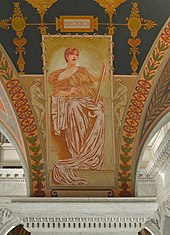
Since 1988, the library has administered the National Moving picture Preservation Board. Established by congressional mandate, information technology selects American films annually for preservation and inclusion in the new National Registry, a drove of American films. The library has made these bachelor on the Internet for gratis streaming.[45] By 2015, the librarian had named 650 films to the registry.[46] The films in the collection appointment from the primeval to ones produced more ten years ago; they are selected from nominations submitted to the lath. Further programs included:
- Gershwin Prize for Popular Vocal,[47] was launched in 2007 to honor the work of an artist whose career reflects lifetime achievement in song composition. Winners have included Paul Simon, Stevie Wonder, Paul McCartney, Burt Bacharach and Hal David, Carole King, Billy Joel, and Willie Nelson, as of 2015. The library also launched the Living Legend Awards in 2000 to honor artists, activists, filmmakers, and others who have contributed to America'due south diverse cultural, scientific, and social heritage;
- Fiction Prize (now the Library of Congress Prize for American Fiction) was started in 2008 to recognize distinguished lifetime achievement in the writing of fiction.[48]
- World Digital Library, established in association with UNESCO and 181 partners in 81 countries in 2009, makes copies of professionally curated primary materials of the world's varied cultures freely bachelor online in multiple languages.[49]
- National Jukebox, launched in 2011, provides streaming free online access to more than than 10,000 out-of-print music and spoken give-and-take recordings.[50]
- BARD was started in 2013; it is a digital, talking books mobile app for braille and audio reading downloads, in partnership with the library's National Library Service for the bullheaded and physically handicapped. It enables free downloads of audio and braille books to mobile devices via the Apple App Shop.[51]
During Billington's tenure, the library acquired General Lafayette's papers in 1996 from a castle at La Grange, French republic; they had previously been inaccessible. Information technology as well caused the but copy of the 1507 Waldseemüller world map ("America's nativity certificate") in 2003; information technology is on permanent display in the library's Thomas Jefferson Edifice. Using privately raised funds, the Library of Congress has created a reconstruction of Thomas Jefferson's original library. This has been on permanent display in the Jefferson building since 2008.[52]
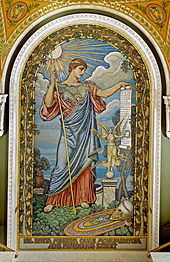
Nether Billington, public spaces of the Jefferson Edifice were enlarged and technologically enhanced to serve as a national exhibition venue. Information technology has hosted more 100 exhibitions.[53] These included exhibits on the Vatican Library and the Bibliothèque Nationale de France, several on the Ceremonious War and Lincoln, on African-American culture, on Organized religion and the founding of the American Democracy, the Early on Americas (the Kislak Collection became a permanent display), on the global celebration commemorating the 800th anniversary of the Magna Carta, and on early American press, featuring the Rubenstein Bay Psalm Book. Onsite access to the Library of Congress has been increased. Billington gained an underground connection between the new U.South. Capitol Visitors Heart and the library in 2008 in order to increase both congressional usage and public tours of the library's Thomas Jefferson Building.[37]
In 2001, the library began a mass deacidification program, in gild to extend the lifespan of almost 4 million volumes and 12 meg manuscript sheets. Since 2002, new collection storage modules at Fort Meade have preserved and made attainable more than than 4 million items from the library's analog collections.
Billington established the Library Collections Security Oversight Commission in 1992 to improve protection of collections, and also the Library of Congress Congressional Caucus in 2008 to draw attending to the library'due south curators and collections. He created the library'due south first Immature Readers Center in the Jefferson Building in 2009, and the start large-scale summer intern (Junior Fellows) plan for academy students in 1991.[54] Under Billington, the library sponsored the Gateway to Cognition in 2010–2011, a mobile exhibition to 90 sites, covering all states east of the Mississippi, in a peculiarly designed 18-bike truck. This increased public admission to library collections off-site, particularly for rural populations, and helped raise awareness of what was also available online.[55]
Billington raised more than one-half a billion dollars of private support to supplement Congressional appropriations for library collections, programs, and digital outreach. These private funds helped the library to continue its growth and outreach in the face of a xxx% decrease in staffing, caused mainly past legislative appropriations cutbacks. He created the library's first development office for individual fundraising in 1987. In 1990, he established the James Madison Quango, the library's starting time national private sector donor-back up group. In 1987, Billington also asked the GAO to behave the first library-wide audit. He created the offset Role of the Inspector General at the library to provide regular, independent reviews of library operations. This precedent has resulted in regular annual fiscal audits at the library; information technology has received unmodified ("clean") opinions from 1995 onward.[37]
In April 2010, the library announced plans to archive all public communication on Twitter, including all communication since Twitter's launch in March 2006.[56] As of 2015[update], the Twitter archive remains unfinished.[57]
Before retiring in 2015, after 28 years of service, Billington had come "under pressure" every bit librarian of Congress.[58] This followed a Regime Accountability Office (GAO) study that described a "work environment lacking key oversight" and faulted Billington for "ignoring repeated calls to hire a chief information officeholder, as required by police force."[59]
When Billington announced his plans to retire in 2015, commentator George Weigel described the Library of Congress every bit "ane of the terminal refuges in Washington of serious bipartisanship and calm, considered conversation," and "one of the globe's greatest cultural centers."[60]
Carla Hayden was sworn in every bit the 14th librarian of Congress on September 14, 2016, the first adult female and the offset African American to hold the position.[61] [62]
In 2017, the library announced the Librarian-in-Residence programme, which aims to support the futurity generation of librarians past giving them the opportunity to gain work experience in v different areas of librarianship including: Acquisitions/Collection Development, Cataloging/Metadata, and Drove Preservation.[63]
On January 6, 2021, at 1:11 PM EST, the Library's Madison Building and the Cannon Firm Role Building were the offset buildings in the Capitol Complex to be ordered to evacuate as rioters breached security perimeters before storming the Capitol building.[64] [65] [66] Carla Hayden antiseptic 2 days subsequently that rioters did non breach any of Library's buildings or collections and all staff members were safely evacuated.[67]
Holdings [edit]

Thomas Jefferson Building the library's main edifice
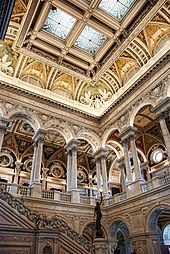

Ceiling of the Great Hall
The collections of the Library of Congress include more than 32 million catalogued books and other print materials in 470 languages; more than than 61 million manuscripts; the largest rare book drove[68] in Northward America, including the rough draft of the Declaration of Independence, a Gutenberg Bible (originating from the Saint Blaise Abbey, Black Forest—one of just three perfect vellum copies known to be);[69] [seventy] [71] over 1 million U.Due south. government publications; 1 million issues of earth newspapers spanning the by iii centuries; 33,000 spring paper volumes; 500,000 microfilm reels; U.S. and foreign comic books—over 12,000 titles in all, totaling more than 140,000 issues;[72] films; 5.3 million maps; half-dozen million works of sail music; 3 million audio recordings; more than xiv.seven million prints and photographic images including fine and popular art pieces and architectural drawings;[73] the Betts Stradivarius; and the Cassavetti Stradivarius.
The library adult a system of volume classification chosen Library of Congress Classification (LCC), which is used by nigh US research and university libraries.
The library serves as a legal repository for copyright protection and copyright registration, and as the base of operations for the The states Copyright Office. Regardless of whether they register their copyright, all publishers are required to submit ii consummate copies of their published works to the library—this requirement is known every bit mandatory eolith.[74] Nearly 15,000 new items published in the U.S. make it every business day at the library. Opposite to pop belief, still, the library does not retain all of these works in its permanent collection, although it does add together an average of 12,000 items per day.[three] Rejected items are used in trades with other libraries around the world, distributed to federal agencies, or donated to schools, communities, and other organizations within the United States.[three] Every bit is truthful of many similar libraries, the Library of Congress retains copies of every publication in the English language that is deemed significant.
The Library of Congress states that its drove fills most 838 miles (1,349 km) of bookshelves,[5] while the British Library reports about 388 miles (624 km) of shelves.[75] The Library of Congress holds more than than 167 million items with more 39 meg books and other print materials,[5] confronting approximately 150 million items with 25 meg books for the British Library.[75] A 2000 study past information scientists Peter Lyman and Hal Varian suggested that the amount of uncompressed textual data represented by the 26 million books and so in the drove was 10 terabytes.[76]
The library as well administers the National Library Service for the Bullheaded and Physically Handicapped, an sound volume and braille library program provided to more than 766,000 Americans.
Digitization [edit]
The library's first digitization project was chosen "American Memory". Launched in 1990, it initially planned to choose 160 meg objects from its collection to make digitally available on laserdiscs and CDs that would be distributed to schools and libraries. After realizing that this programme would be as well expensive and inefficient, and with the rise of the Cyberspace, the library decided to instead make digitized material available over the Internet. This project was fabricated official in the National Digital Library Program (NDLP), created in October 1994. By 1999, the NDLP had succeeded in digitizing over 5 million objects and had a budget of $12 million. The library has kept the "American Retentivity" name for its public domain website, which today contains xv million digital objects, comprising over 7 petabytes.[77]
American Memory is a source for public domain paradigm resources, too as audio, video, and archived Web content. Near all of the lists of holdings, the catalogs of the library, tin be consulted straight on its website. Librarians all over the earth consult these catalogs, through the Web or through other media amend suited to their needs, when they need to itemize for their collection a book published in the U.s.a.. They use the Library of Congress Command Number to brand certain of the exact identity of the book. Digital images are also available at Snapshots of the Past, which provides archival prints.[78]
The library has a budget of $6–viii million each year for digitization, meaning that not all works can be digitized. It makes determinations about what objects to prioritize based on what is specially important to Congress or potentially interesting for the public. The fifteen 1000000 digitized items represent less than 10% of the library's total 160-million item collection.
The library has chosen not to participate in other digital library projects such as Google Books and the Digital Public Library of America, although it has supported the Cyberspace Archive project.[77]
THOMAS and Congress.gov projects [edit]
In 1995, the Library of Congress established an online archive of the proceedings of the U.S. Congress, THOMAS. The THOMAS website included the total text of proposed legislation, every bit well every bit bill summaries and statuses, Congressional Record text, and the Congressional Tape Index. The THOMAS organization received major updates in 2005 and 2010. A migration to a more modernized Web organization, Congress.gov, began in 2012, and the THOMAS system was retired in 2016.[79] Congress.gov is a joint project of the Library of Congress, the House, the Senate and the Authorities Publishing Office.[80]
Library of Congress buildings [edit]

The Library of Congress is physically housed in three buildings on Capitol Hill and a conservation center in rural Virginia. The library's Capitol Hill buildings are all continued past cloak-and-dagger passageways, so that a library user need pass through security only once in a single visit. The library also has off-site storage facilities for less normally requested materials.
Thomas Jefferson Building [edit]
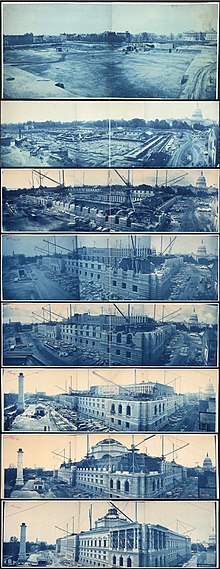
The Thomas Jefferson Building is located between Independence Avenue and East Capitol Street on Outset Street SE. It first opened in 1897 as the main building of the library and is the oldest of the three buildings. Known originally as the Library of Congress Building or Main Building, it took its nowadays name on June 13, 1980.[81]
John Adams Building [edit]
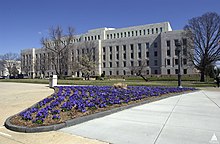
The John Adams Building is located between Independence Avenue and East Capitol Street on 2nd Street SE, the block adjacent to the Jefferson Building. The building was originally known as The Annex to the Main Building, which had run out of infinite. Information technology opened its doors to the public on January 3, 1939.[82] Initially, it besides housed the U.S. Copyright Office which moved to the Madison edifice in the 1970s.
James Madison Memorial Edifice [edit]

The James Madison Memorial Building is located between Commencement and Second Streets on Independence Artery SE. The building was constructed from 1971 to 1976, and serves as the official memorial to President James Madison.[83]
The Madison Building is also home to the U.S. Copyright Office and to the Mary Pickford Theater, the "motion picture and tv set reading room" of the Library of Congress. The theater hosts regular complimentary screenings of classic and gimmicky movies and boob tube shows.[84]
Packard Campus for Acoustic Conservation [edit]
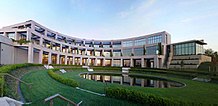
The Packard Campus for Audio-Visual Conservation is the Library of Congress'south newest building, opened in 2007 and located in Culpeper, Virginia.[85] It was constructed out of a former Federal Reserve storage center and Cold War bunker. The campus is designed to human activity as a single site to store all of the library's movie, television, and sound collections. It is named to honor David Woodley Packard, whose Packard Humanities Constitute oversaw the blueprint and construction of the facility. The centerpiece of the complex is a reproduction Art Deco movie theater that presents free motion picture screenings to the public on a semi-weekly footing.[86]
Digital Millennium Copyright Act [edit]
The Library of Congress, through both the librarian of Congress and the annals of copyrights, is responsible for authorizing exceptions to Section 1201 of Championship 17 of the U.s.a. Lawmaking equally part of the Digital Millennium Copyright Act. This procedure is washed every iii years, with the register receiving proposals from the public and interim as an advisor to the librarian, who bug a ruling on what is exempt. Later three years have passed, the ruling is no longer valid and a new ruling on exemptions must be made.[87] [88]
Admission [edit]
The library is open for academic research to anyone with a Reader Identification Card. One may not remove library items from the reading rooms or the library buildings. Near of the library's general collection of books and journals are in the closed stacks of the Jefferson and Adams Buildings; specialized collections of books and other materials are in closed stacks in all iii primary library buildings, or are stored off-site. Access to the closed stacks is not permitted under any circumstances, except to authorized library staff, and occasionally, to dignitaries. Only the reading room reference collections are on open up shelves.[89]
Since 1902, American libraries have been able to request books and other items through interlibrary loan from the Library of Congress if these items are not readily bachelor elsewhere. Through this organization, the Library of Congress has served as a "library of last resort", according to former Librarian of Congress Herbert Putnam.[34] The Library of Congress lends books to other libraries with the stipulation that they be used but inside the borrowing library.[90]
Standards [edit]
In add-on to its library services, the Library of Congress is also actively involved in diverse standard activities in areas related to bibliographical and search and retrieve standards. Areas of work include MARC standards, Metadata Encoding and Transmission Standard (METS), Metadata Object Clarification Schema (MODS), Z39.fifty and Search/Retrieve Web Service (SRW), and Search/Recall via URL (SRU).[91]
The Police Library of Congress seeks to further legal scholarship by providing opportunities for scholars and practitioners to deport significant legal research. Individuals are invited to apply for projects which would further the multi-faceted mission of the law library in serving the U.S. Congress, other governmental agencies, and the public.[92]
Annual events [edit]
- Fellows in American Letters of the Library of Congress
- Gershwin Prize for Popular Song
- Library of Congress Prize for American Fiction
- Founder's Day Celebration
- National Book Festival
- Mostly Lost Pic Identification Workshop
Notable personnel [edit]
- Henriette Avram: Developed the MARC format (Machine Readable Cataloging), the international data standard for bibliographic and holdings information in libraries.
- John Y. Cole: founder of the Middle for the Volume and first historian of the Library of Congress.
- Cecil Hobbs: American scholar of Southeast Asian history, head of the Southern Asia Section of the Orientalia (at present Asian) Division of the Library of Congress, and a major contributor to scholarship on Asia and the development of South East Asian coverage in American library collections[93]
- Julius C. Jefferson Jr., head of the Congressional Research Service, president of the American Library Association (2020–2021), president of the Freedom to Read Foundation (2013–2016).
Encounter too [edit]
- Documents Expediting Project
- Federal Research Sectionalisation
- Feleky Collection
- Law Library of Congress
- Library of Congress Classification
- Library of Congress Country Studies
- Library of Congress Living Legend
- Library of Congress Subject Headings
- Minerva Initiative
- National Digital Library Program (NDLP)
- National Pic Registry
- National Recording Registry
- National Archives and Records Assistants
- United States Senate Library
Notes [edit]
- ^ The collection includes: 25 one thousand thousand catalogued books, xv.5 meg other print items, 4.2 1000000 recordings, 74.5 1000000 manuscripts, 5.six million maps, and viii.2 1000000 sheet music pieces.[one]
References [edit]
- ^ "Yr 2020 at a Glance". Library of Congress. 2020. Retrieved November 5, 2021.
- ^ a b "2017 Annual Study of the Librarian of Congress" (PDF). Library of Congress. Retrieved November 27, 2018.
- ^ a b c d "Fascinating Facts". Library of Congress. Retrieved Apr 25, 2018.
- ^ "Library of Congress". Encyclopedia Britannica . Retrieved September three, 2017.
- ^ a b c "Fascinating Facts – Statistics". The Library of Congress . Retrieved February 16, 2017.
- ^ "History of the Library of Congress". Library of Congress . Retrieved October 20, 2020.
- ^ "FY 2019–2023 Strategic Plan of the Library of Congress". Library of Congress. Library of Congress. Retrieved October 20, 2020.
- ^ a b Murray, Stuart. The Library: An Illustrated History (New York, Skyhouse Publishing, 2012): 155.
- ^ ii Stat. 55
- ^ a b c d due east f g h i j thou l "Jefferson'southward Legacy: A Brief History of the Library of Congress". Library of Congress. March 6, 2006. Retrieved January 14, 2008.
- ^ two Stat. 128
- ^ a b Murray, Stuart P. (2009). The library: an illustrated history. New York, NY: Skyhorse Pub. pp. 158. ISBN9781602397064.
- ^ Greenpan, Jesse (August 22, 2014). "The British Burn Washington, D.C., 200 Years Ago". History.com . Retrieved Jan 8, 2021.
- ^ Murray, Stuart (2009). The Library An Illustrated History. Chicago, Illinois: Skyhorse Publishing. p. 159.
- ^ Murray, Stuart (2009). The library : an illustrated history . New York, NY: Skyhorse Pub. ISBN978-1-60239-706-4.
- ^ "Thomas Jefferson'due south personal library, at LibraryThing, based on scholarship". LibraryThing. Retrieved November 4, 2012.
- ^ LibraryThing profile page for Thomas Jefferson'southward library, summarizing contents and indicating sources
- ^ "Jefferson's Library". Library of Congress. April 24, 2000.
- ^ a b Murray, Stuart P. (2009). The library : an illustrated history. Chicago: Skyhorse Pub. pp. 162. ISBN9781602397064.
- ^ Murray, Stuart A.P. The Library: An Illustrated History. Skyhorse Publishing, 2012. 9781616084530, pp. 161
- ^ Murray, Stuart (2009). The Library: An Illustrated History. New York: Skyhorse Publishing. p. 162. ISBN978-1-60239-706-4.
- ^ a b Cole, J.Y. (1993). Jefferson's Legacy: a brief history of the Library of Congress. Washington, D.C.: Library of Congress. p. 14.
- ^ Fineberg, Gail (June 2007). "Thomas Jefferson's Library". The Gazette. Library of Congress. 67 (6). Retrieved Jan 4, 2015.
- ^ Cole, J.Y. (2005). "The Library of Congress Becomes a Earth Leader, 1815–2005". Libraries & Civilization. xl (3): 386. doi:10.1353/lac.2005.0046. S2CID 142764409.
- ^ Interior Library (Baronial four, 2015). "History of the Interior Library". U.Southward. Department for the Interior . Retrieved April 30, 2018.
- ^ Smithsonian Institution (1904). An Account Of The Smithsonian: Its Origin, History, Objects and Achievements. Washington, D.C. p. 12.
- ^ Mearns, D.C. (1946). The Story Up to Now: The Library of Congress, 1800–1946. Washington, D.C.: Authorities Printing Office. p. 100.
- ^ Library of Congress. "Annual Report of the Librarian of Congress 1866" (PDF). U.Due south. Copyright Role . Retrieved April thirty, 2018.
- ^ Gwinn, Nancy. "History". Smithsonian Libraries . Retrieved April 30, 2018.
- ^ a b c d Library of Congress. "John Grand Stephenson". John G Stephenson – Previous Librarians of Congress . Retrieved April 30, 2018.
- ^ Aikin, Jane (2010). "Histories of the Library of Congress". Libraries & the Cultural Record. 45 (1): eleven–12. ISSN 1932-4855. JSTOR 20720636.
- ^ Weeks, Linton (December xiii, 1999). "A Bicentennial for the Books". The Washington Post . Retrieved October 3, 2021.
- ^ These included futurity Librarian of Congress Herbert Putnam and Melvil Dewey of the New York State Library.
- ^ a b "Interlibrary Loan (Collections Admission, Direction and Loan Segmentation, Library of Congress)". Library of Congress website. October 25, 2007. Retrieved December four, 2007.
- ^ Snapp, Elizabeth (April 1975). "The Acquisition of the Vollbehr Collection of Incunabula for the Library of Congress". The Journal of Library History. University of Texas Press. ten (2): 152–161. JSTOR 25540624. (restricted admission)
- ^ Cole, John Y. "The James Madison Building (On These Walls: Inscriptions and Quotations in the Buildings of the Library of Congress, past John Y. Cole)". www.loc.gov . Retrieved February 20, 2022.
- ^ a b c "Primal Milestones of James H. Billington's Tenure | News Releases – Library of Congress". Loc.gov . Retrieved September 22, 2015.
- ^ "American Retention from the Library of Congress – Dwelling Page". Memory.loc.gov . Retrieved September 22, 2015.
- ^ "Congress.gov | Library of Congress". www.congress.gov . Retrieved September 22, 2015.
- ^ Oder, Norman. "Beginning Lady Launches Volume Festival." Library Journal 126, no. 14 (2001): 17
- ^ "2015 Book Festival | National Book Festival – Library of Congress". Loc.gov . Retrieved September 22, 2015.
- ^ "The John W. Kluge Middle – Library of Congress". Loc.gov . Retrieved September 22, 2015.
- ^ "Founding Chairman | OpenWorld". world wide web.openworld.gov. Archived from the original on September 5, 2015. Retrieved September 22, 2015.
- ^ "Veterans History Project (Library of Congress)". Loc.gov . Retrieved September 22, 2015.
- ^ Dargis, Manohla, Film Treasures, Streaming Courtesy of the Library of Congress, New York Times, Apr 3, 2020 with links to videos and collections, and on April 4, 2020, Department C, Page i, New York edition with the headline: An Online Trove of Film Treasures
- ^ "Within the Nuclear Bunker Where America Preserves Its Movie History". Wired . Retrieved September 22, 2015.
- ^ "Gershwin Prize". Library of Congress . Retrieved September 22, 2015.
- ^ "Fiction Prize". Library of Congress . Retrieved September 22, 2015.
- ^ "Background – World Digital Library". www.wdl.org . Retrieved September 22, 2015.
- ^ "National Jukebox LOC.gov". Loc.gov . Retrieved September 22, 2015.
- ^ "NLS Habitation". Loc.gov . Retrieved September 22, 2015.
- ^ "Thomas Jefferson's Library | Exhibitions – Library of Congress". loc.gov. April 11, 2008. Retrieved September 22, 2015.
- ^ "All Exhibitions – Exhibitions (Library of Congress)". Loc.gov . Retrieved September 22, 2015.
- ^ "2015 Junior Fellows Summertime Intern Plan Home (Library of Congress)". Loc.gov . Retrieved September 22, 2015.
- ^ "Gateway to Knowledge – Educational Resource – Library of Congress". Loc.gov . Retrieved September 22, 2015.
- ^ Grier, Peter (Apr 16, 2010). "Twitter hits Library of Congress: Would Founding Fathers tweet?". Christian Science Monitor . Retrieved January iv, 2015.
- ^ Zimmer, Michael (2015). "The Twitter Archive at the Library of Congress: Challenges for information practice and data policy". First Monday. doi:10.5210/fm.v20i7.5619.
- ^ "Librarian of Congress gets a Due Appointment" by Maria Recio, McClatchy DC, Oct. 30. 2015
- ^ "America's 'national library' is lacking in leadership, yet another report finds" by Peggy McGlone, The Washington Mail service, March 31, 2015.
- ^ "America's Next 'Minister of Culture': Don't Politicize the Date". National Review. June 12, 2015. Retrieved September 22, 2015.
- ^ McGlone, Peggy (July 13, 2016). "Carla Hayden confirmed as 14th librarian of Congress". Washingtonpost.com . Retrieved May 5, 2017.
- ^ "Carla Hayden to exist sworn in on September fourteen – American Libraries Magazine". Americanlibrariesmagazine.org. Archived from the original on May 10, 2017. Retrieved May v, 2017.
- ^ "Librarians-in-Residence -". The Library of Congress . Retrieved November 7, 2017.
- ^ Budryk, Zack; Lillis, Mike; Coleman, Justine (January 6, 2021). "Capitol placed on lockdown, buildings evacuated amid protests". The Hill . Retrieved January 8, 2021.
- ^ "Timeline: How a Trump mob stormed the Usa Capitol, forcing Washington into lockdown". USA Today. January 8, 2021. Retrieved Jan 8, 2021.
- ^ @sarahnferris (Jan half dozen, 2021). "WOW Hill staff only got this alarm "Madison: EVACUATE. Go along to your designated assembly area. USCP"" (Tweet) – via Twitter.
- ^ Hayden, Carla (January 8, 2021). "Thoughts on this week's unrest" (PDF). The Library of Congress Gazette. 32.
- ^ "Rare Book and Special Collections Reading Room (Library of Congress)". Loc.gov . Retrieved May v, 2017.
- ^ Nga, Brett. "Gutenberg'south Bibles— Where to Find Them". ApprovedArticles.com. Archived from the original on July vi, 2008. Retrieved April ane, 2008.
- ^ "Octavo Editions: Gutenberg Bible". octavo.com. Archived from the original on November 27, 2004.
- ^ "Europe (Library of Congress Rare Books and Special Collections: An Illustrated Guide)". Loc.gov . Retrieved May 5, 2017.
- ^ "Comic Volume Collection". The Library of Congress. Baronial 27, 2020. Retrieved Baronial 27, 2020.
- ^ Annual Report of the Librarian of Congress (PDF), Library of Congress, 2009
- ^ "Mandatory Deposit". Copyright.gov. Retrieved August eight, 2006.
- ^ a b "Facts and figures". British Library. Archived from the original on February 7, 2010. Retrieved June 30, 2011.
- ^ Lyman, Peter; Varian, Hal R. (October 18, 2000). "How Much Data?" (PDF) . Retrieved Oct 14, 2013.
- ^ a b Chayka, Kyle (July xiv, 2016). "The Library of Final Resort". north+1 Magazine. Archived from the original on January 19, 2018. Retrieved July 19, 2016.
- ^ "Nigh Us". Snapshots of the By . Retrieved April 26, 2016.
- ^ David Gewirtz, So long, Thomas.gov: Inside the retirement of a classic Spider web 1.0 application, ZDNet (May 4, 2016).
- ^ Adam Mazmanian, Library of Congress to retire Thomas, Federal Computer Calendar week (April 28, 2016).
- ^ Cole, John (2008). "The Thomas Jefferson Building". On These Walls: Inscriptions and Quotations in the Buildings of the Library of Congress. Scala Arts Publishers Inc. ISBN978-1857595451 . Retrieved April 23, 2018.
- ^ Cole, John (2008). "The John Adams Edifice". On These Walls: Inscriptions and Quotations in the Buildings of the Library of Congress. Scala Arts Publishers Inc. ISBN978-1857595451 . Retrieved April 23, 2018.
- ^ Cole, John (2008). "The James Madison Memorial Building". On These Walls: Inscriptions and Quotations in the Buildings of the Library of Congress. Scala Arts Publishers Inc. ISBN978-1857595451 . Retrieved April 23, 2018.
- ^ "Mary Pickford Theater Film Schedule". Moving Image Enquiry Center. Library of Congress. Retrieved April 23, 2018.
- ^ "The Packard Campus – A/Five Conservation (Library of Congress)". Loc.gov . Retrieved May 5, 2017.
- ^ "Library of Congress events list". Loc.gov. Retrieved November 4, 2012.
- ^ "Section 1201: Exemptions to Prohibition Against Circumvention of Technological Measures Protecting Copyrighted Works". United states of america Copyright Office. 2013. Retrieved July 26, 2014.
- ^ "Statement Regarding White House Response to 1201 Rulemaking" (Press release). Library of Congress. 2013. Retrieved July 26, 2014.
- ^ "Using the Library's Collections (Research and Reference Services, Library of Congress)". www.loc.gov . Retrieved February 23, 2022.
- ^ "Subpage Title (Interlibrary Loan, Library of Congress)". Loc.gov. July 14, 2010. Retrieved Nov 4, 2012.
- ^ "Standards at the Library of Congress". Loc.gov . Retrieved May 5, 2017.
- ^ "Inquiry & Educational Opportunities – Law Library of Congress". Loc.gov . Retrieved May 5, 2017.
- ^ Tsuneishi, Warren (May 1992). "Obituary: Cecil Hobbs (1907–1991)". Periodical of Asian Studies. 51 (two): 472–473. doi:10.1017/s0021911800041607.
- Mearns, David Chambers. The Story Upward to Now: The Library Of Congress, 1800–1946 (1947), detailed narrative
Architecture [edit]
- Cole, John Y. and Henry Hope Reed. The Library of Congress: The Fine art and Compages of the Thomas Jefferson Building (1998) extract and text search
- Small-scale, Herbert, and Henry Hope Reed. The Library of Congress: Its Architecture and Ornament (1983)
Farther reading [edit]
- Aikin, Jane (2010). "Histories of the Library of Congress". Libraries & the Cultural Record. 45 (1): 5–24. doi:10.1353/lac.0.0113. S2CID 161865550.
- Anderson, Gillian B. (1989), "Putting the Experience of the Globe at the Nation'southward Command: Music at the Library of Congress, 1800-1917", Periodical of the American Musicological Society, 42 (i): 108–49, doi:10.2307/831419, JSTOR 831419
- Bisbort, Alan, and Linda Barrett Osborne. The Nation's Library: The Library of Congress, Washington, D. C. (Library of Congress, 2000)
- Cole, John Young. Jefferson's legacy: a brief history of the Library of Congress (Library of Congress, 1993)
- Cole, John Young. "The library of congress becomes a world library, 1815–2005." Libraries & culture (2005) 40#three: 385–398. in Project MUSE
- Cope, R. L. "Management Review of the Library of Congress: The 1996 Booz Allen & Hamilton Written report," Australian Academic & Research Libraries (1997) 28#1 online
- Ostrowski, Carl. Books, Maps, and Politics: A Cultural History of the Library of Congress, 1783–1861 (2004) online
- Rosenberg, Jane Aiken. The Nation's Groovy Library: Herbert Putnam and the Library of Congress, 1899–1939 (University of Illinois Press, 1993)
- Shevlin, Eleanor F.; Lindquist, Eric N. (2010). "The Eye for the Book and the History of the Book". Libraries & the Cultural Record. 45 (1): 56–69. doi:10.1353/lac.0.0112. S2CID 161311744.
- Tabb, Winston; et al. (2003). "Library of Congress". Encyclopedia of Library and Informatics. 3: 1593–1612.
External links [edit]
- The Library of Congress website
- Library of Congress YouTube channel
- Search the Library of Congress catalog
- Congress.gov, legislative information
- Library Of Congress Meeting Notices and Rule Changes from The Federal Register RSS Feed
- Library of Congress photos on Flickr
- Outdoor sculpture at the Library of Congress
- Works by Library of Congress at Project Gutenberg
- Works by or about Library of Congress at Net Archive
- Library of Congress at FamilySearch Enquiry Wiki for genealogists
- . Encyclopedia Americana. 1920.
- C-Bridge'southward Library of Congress documentary and resources
- The Library of Congress National Library Service (NLS)
- Video: "Library of Congress in 1968 – Computer Automation"
- Library of Congress Web Archives – search by URL
Source: https://en.wikipedia.org/wiki/Library_of_Congress
0 Response to "Is Anyone Allowed in the Reading Room of the Library of Congress"
Postar um comentário